Showing posts with label The Tragedy of the Commons. Show all posts

Tuesday, 12 May 2026

Is Rave Culture Everything It Is Set Out To Be?


Imagine a world where everyone worked together to form a collective, a world in pursuit of belonging and inclusivity, a world chasing euphoria through music and dance. This is what defines rave culture. Spread by word of mouth, misfits and music lovers overwhelmed warehouses, branching out across the underground scene with party drugs fueling the nights. Raving has since been popularised, with like-minded people gathering to witness the glory that the free party culture holds. However, behind the neon lights, there comes a cost, but to whom does this cost lie?


The Welfare Loss of the Afterparty

In a free market, all agents operate to benefit themselves, exchanging information on their needs, wants, and capabilities. Subsequently, the market reacts to changes in this information, resulting in fluctuations in price and quantity demanded. However, this doesn't always reflect the full cost of producing and/or consuming a service. There are hidden costs to third parties when a service is produced or consumed that economists call negative externalities. When ravers engage in the free party movement, they find joy through community; however, this forms large crowds prone to littering in local areas and damaging the environment. The accumulation of litter forms a divergence between the marginal private cost (MPC) that firms cover and the marginal social cost (MSC) that the public endures—what Arthur Pigou described as “the divergence between private and social net product”[1]  (Pigou, 2002). Thus, a market failure from a misallocation of resources unveils, which is not represented in the balance sheet, also known as a Pareto inefficiency.

Cigarette butts and packaging are found in 81% of deprived areas. Due to the unsightly litter, local economies struggle to grow and continue to decline, taking with it the morale of stakeholders (Keep Britain Tidy, 2025). Cigarette companies don't take accountability for the social costs that arise and the psychological toll they cause. They don't take full accountability for their actions; they just pay the price indicated by the market for the sole purpose of maximising profits instead of welfare.

(Keep Britain Tidy, 2025). Is this relatable? In and around all rave venues, a flurry of litter can be found; those who litter don't take responsibility for it, and the rave organisers don't cover the cost of the externality either. Consequently, it is the community that is forced to pay the price, and if left untreated, may contribute to the economic decline in deprived areas.

This process of littering happens regularly in public spaces and rave venues across the world, with one of the most famous cases being The Brighton Beach Boutique II (2002). This was a free event on Brighton Beach, which was non-excludable to the public and non-rivalrous, as there wasn’t a limit to the number of people who could enjoy this experience. With so many positives, what could go wrong?


The event was initially planned for 60,000 attendees, escalating to 250,000 people gathering to witness Fatboy Slim in one of the biggest raves of the decade (Coll, 2022). This is where the cracks began to form, with no clear ownership, and people weren’t held accountable for their actions. The market failure began to show its ugly face. There was a shared view that littering a single item has little to no impact; however, as this behaviour was repeated amongst thousands of ravers, it became a prominent societal issue known as the free-rider problem. The aftermath led to mass amounts of litter scattered across the area, with the clean-up costs imposed on the local council and community. This is a result of the tragedy of the commons, leading to a systematic failure with the under-provision of cleanliness and increased environmental degradation. People have little motivation to safeguard these areas as they belong to everyone but no one in particular (Hardin, 1968).


Correcting Market Failure in Rave Events

The Coase theorem provides an elegant solution to the negative externality associated with rave culture, arguing that when property rights are clearly defined and negotiation is possible, parties involved in an externality can reach an efficient solution without government intervention (Parisi, 2008). In this case, local councils or owners of public spaces could establish agreements with event organisers before a rave takes place. For example, organisers could be required to fund cleanup crews, provide sufficient waste bins, or pay refundable deposits that are only returned once the site is restored to its original condition. This would force organisers to bear part of the social cost created by littering, rather than leaving taxpayers or local communities to absorb the burden. In events like the 2002 Brighton Beach rave, where large amounts of rubbish were left behind, such arrangements could have reduced the damage by making organisers accountable for post-event waste management.

Although the Coase Theorem offers a practical solution for littering, it is difficult to apply to other negative externalities caused by rave culture, such as noise pollution. Due to the high density and transient nature of the crowds, negotiating the social cost becomes complex as it is impractical to identify the affected individuals and determine the extent of the impact (Schneider, 2022).

A more effective solution is a combined strategy with other policies like a Pigouvian tax, which makes those responsible pay for the external cost they create. This could involve charges on single-use items like plastic cups, encouraging organisers and attendees to reduce waste. Unlike the Coase Theorem, this approach is more practical for large events where negotiation is difficult. The revenue generated can also fund cleanup and environmental restoration, helping to offset the damage caused.


When Celebration Comes at a Cost

If short-term enjoyment is prioritised over its wider social costs, the consequences will fall back on society. What seems harmless—such as littering—accumulates into long-term damage to shared spaces and communities. While solutions like the Coase Theorem and Pigouvian tax offer some accountability, they are not always enough. Ultimately, balancing enjoyment with responsibility is key to preventing these hidden costs.

References


Coll, T. (2022). 20 years on from Fatboy Slim’s mammoth Brighton beach party. [online] Far Out Magazine. Available at: https://faroutmagazine.co.uk/fatboy-slim-beach-party-20-years-on/ [Accessed 24 Apr. 2026].

Hardin, G. (1968). The Tragedy of the Commons. Source: Science, New Series, [online] 162(3859), pp.1243–1248. Available at: https://pages.mtu.edu/~asmayer/rural_sustain/governance/Hardin%201968.pdf.

Keep Britain Tidy. (2025). A Rubbish Reality Our litter Problem and Why is Matters. [online] Available at: https://www.keepbritaintidy.org/sites/default/files/2025-11/KBT%20Rubbish%20Reality%20Report%20Jan%2025.pdf#:~:text=Smoking%2Drelated%20litter%20(cigarette%20butts,survey%20was%20carried%20out%20in [Accessed 24 Apr. 2026]

            Parisi, F. (2008). Coase theorem. The New Palgrave Dictionary of Economics. Palgrave Macmillan, London. https://doi.org/10.1007/978-1-349-58802-2_251

Pigou, A.C. (2002). The Economics of Welfare. New Brunswick, N.J. ; London Transaction Publ. C.

            Schneider, N. (2022) “Internalizing Environmental Externalities and the Coase Theorem”, World Journal of Applied Economics, 8(2), pp. 93-100. doi: 10.22440/wjae.8.2.4.


Tuesday, 29 April 2025

Rush Hour Economics: Does Congestion Pricing Work?


Figure 1: Traffic Congestion  Source: Dreamstine.com@Ruslan Sitarchuk

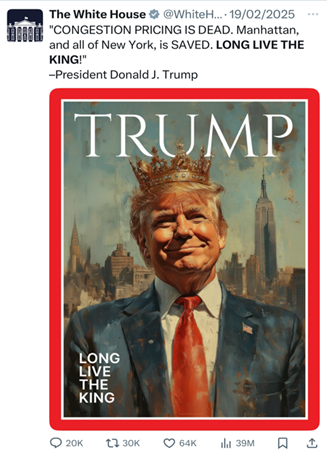
Figure 2: A Post From the Trump Administration Source: X@WhiteHouse

Have you ever been stuck in traffic, watching the minutes tick by while your frustration rises? You're not alone. The average commuter wastes 54 hours and over $1,000 annually in congestion! While London, Singapore, and Stockholm tackled this problem with congestion pricing, New York City's similar plan was abruptly halted in March 2024 by the Trump administration. Why was the plan terminated? Do these pricing schemes actually work? Let me show you how traffic jams reveal surprising lessons about economics.

Why Our Driving Affects Others? Negative Side Effects

When you drive into a congested area, you're thinking about your own costs – gas, time, maybe parking. What you're not considering are the costs you're imposing on everyone else. Each additional car on a busy road slows down traffic for everyone, creating what economists call a "negative externality." This concept was first formalized by Arthur Cecil Pigou back in 1920, but it perfectly explains our modern traffic woes. 


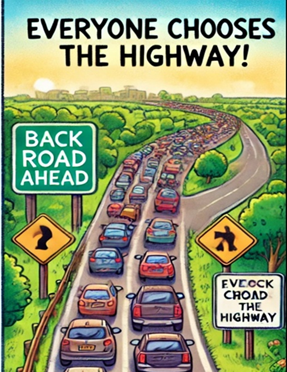
Figure 3: Two-Road Scenario Source: AI generated 


Figure 4: Pigouvian environmental tax on negative externalities. Source: Nerudova, D., Dobranschi, M., & Adam, V. (2019). Can Pigouvian taxation internalize the social cost of platinum-group element emissions? 

Imagine two routes between the same points – a highway and a slower back road. Everybody naturally chooses the highway based on their own benefit. But as more people make this choice, the highway gets congested, eventually becoming slower than the alternative! This happens because we don't pay for the delay we cause others when we join an already crowded road.


This externality creates a gap between the private cost that individuals consider and the true social cost of their actions. As shown in the diagram, without tax, we're stuck at inefficient point A where people overconsume because they ignore external costs. The tax fixes this by making consumers face true social costs, shifting us to optimal point B at quantity Q₁. The shaded triangle represents the eliminated inefficiency – economic gain from cutting wasteful consumption! The tax reduces congestion to an efficient level and maximizes overall welfare.​​​​​​​​​​​​​​​

Why ‘Free’ Roads Get Overused? The Commons Problem

Urban streets represent what economists call a "common resource" – something anybody can use (non-excludable) but where one person's usage reduces availability for others (rival). This classification explains why road networks inevitably face overuse and congestion without proper management.

As Frank Knight insightfully observed back in 1924, if roads were privately owned, owners would naturally charge more during peak periods to maximize value. Roads are mostly government-owned but unpriced, meaning costs remain chronically below their true value, leading to excess demand. This early insight connects traffic directly to what economists now call the "tragedy of the commons" – when a shared resource gets overused because no individual bears the full cost of their consumption.

During peak periods, this divergence becomes even more pronounced - think of roads like an all-you-can-eat buffet with no price difference between peak and off-peak hours. Of course, it gets overcrowded at dinner time! The result is wasted time, excessive pollution, and economic inefficiency that costs modern economies billions annually.

This example extends perfectly to busy urban centers where the problem intensifies dramatically. City centers experience the worst congestion precisely because they're valuable destinations where many people want to be simultaneously. Without proper pricing mechanisms, we create artificial scarcity through queuing rather than efficient allocation through market signals, turning potentially productive time into wasteful waiting.​​​​​​​​​​​​​​​​

Why We Keep Choosing Busy Roads? Psychological Insights

People sometimes make irrational decisions—we keep choosing routes that always seem to be congested. Behavioral economics reveals several fascinating biases affecting our transportation choices. 


Figure 5: Behavioral Economics is about our mind

At first, we hate changing routines: Most commuters never seriously reconsider their route or mode, even when alternatives would save time and money. This "status quo bias" keeps us stuck in inefficient patterns. Secondly, we don’t like risks: When considering a longer alternative route, we worry about the risk of spending more time way much more than time wasted on a shorter route's congestion which already equals or exceeds the time needed for the longer route. This "loss aversion" also makes us stuck in inefficient patterns. Hyperbolic discounting explains our persistent choice of congested roads because we irrationally overvalue the immediate gratification of taking a seemingly shorter or more familiar route while severely discounting the future pain of sitting in traffic that we'll experience just minutes later.

These cognitive biases explain why traffic solutions can't rely solely on rational economic incentives. Our decision-making is flawed in predictable ways, creating persistent inefficiencies in transportation networks. Policy solutions must account for these psychological quirks.

What Can Our City Council Do? Possible Solutions

Tax on congestion and pricing on using roads in busy areas are different routes but same destination. When cities implement congestion pricing, they transform roads from "common resources" into what economists call "club goods" – still limited in capacity but now with managed access.

The results from cities brave enough to try this approach have been remarkable: London saw traffic drop 30% in the charging zone with dramatically improved bus service; Singapore maintains free-flowing traffic even during traditional peak hours; and Stockholm experienced a 14% decrease in carbon emissions while significantly reducing commute times. These success stories demonstrate how properly designed pricing mechanisms can effectively balance demand with available capacity, creating more efficient and sustainable urban transport systems that benefit residents through reduced pollution, shorter travel times, and more reliable public transit options.​​​​​​​​​​​​​​​​

Figure 6: The Congestion Charge Zone in London Source: Transport For London (tfl.gov.uk)


Figure 7: Average changes of traffic volumes for different types of roads on weekdays 6:00–19:00, April 2006 compared to April 2005. Source: Eliasson, J., Hultkrantz, L., Nerhagen, L., & Rosqvist, L. S. (2009). The Stockholm congestion-charging trial 2006: Overview of effects. Transport Policy, 16(5), 395-403.

The most sophisticated congestion pricing systems vary by time, location, and vehicle type, but implementation details are crucial. Successful approaches apply behavioral economics: positive framing reduces loss aversion (Kahneman and Tversky's prospect theory); trials overcome status quo bias; and visible revenue investments leverage the availability heuristic. Stockholm exemplifies this—opposition flipped from 70% against to 74% approval after experiencing benefits, demonstrating both preference reversal and Thaler and Sunstein's Nudge Theory principles. These behavioral insights explain why carefully designed implementations succeed where purely economic approaches might fail.​​​​​​​​​​​​​​​​

What We Have Got Now? A Conclusion

Traffic isn't inevitable — it's the predictable result of misaligned economic incentives. NYC's pause on congestion pricing ignores decades of economic insight and global proof that it works. Cities worldwide use smart pricing to cut congestion and boost mobility fairly and effectively. Next time you're stuck in traffic, remember: it's not just traffic engineering, it's about economics. Sometimes the best solution to a problem is putting the right price on it.

Reference List

Eliasson, J., Hultkrantz, L., Nerhagen, L., & Rosqvist, L. S. (2009). The Stockholm congestion-charging trial 2006: Overview of effects. Transport Policy, 16(5), 395-403.

Hardin, G. (1968). The Tragedy of the Commons. Science, 162(3859), 1243-1248.

Kahneman, D., & Tversky, A. (1979). Prospect Theory: An Analysis of Decision under Risk. Econometrica, 47(2), 263-291.

Knight, F. H. (1924). Some fallacies in the interpretation of social cost. The Quarterly Journal of Economics, 38(4), 582-606.

Leape, J. (2006). The London congestion charge. Journal of Economic Perspectives, 20(4), 157-176.

Metcalfe, R., & Dolan, P. (2012). Behavioural economics and its implications for transport. Journal of Transport Geography, 24, 503-511.

Pigou, A. C. (1920). The Economics of Welfare. Macmillan and Company.

Transport for London. (2023). Congestion Charge Impact Assessment. Retrieved from www.tfl.gov.uk/corporate/publications-and-reports

Tuesday, 7 May 2024

Manchester’s Beryl Scheme - Could it ‘Bee’ Better?

We commuters and students are all too familiar with the tedious journey from Fallowfield, down Wilmslow Road, past Lidl and finally on to our destination, be it work or university. But all hope might not be lost. In the bustling streets of Manchester, a new transport revolution has taken place. Could our unlikely saviour from the busy commute take the form of a simple yellow bike? Let us take a look at the hidden world of economics and how it can show us the benefits and drawbacks of the Beryl bike hire scheme.

Behavioural Economics and Economic Benefits

Generally, bike hire schemes are an example of ‘nudge’ economics, a way of incentivising people into behaving a certain way. Cycling is good for you, it has numerous health benefits, both physical and mental. Looking at the Barclays bike scheme in London implemented by Transport for London (TFL). “It (TFL) enabled behavioural change… taking the hassle out of cycling - buying a bike, maintenance, storage - and providing a compelling proposition for consumers” (McCormik, 2011). No longer did people need to worry about paying large up-front costs for a bike or worry about maintaining them. Nowadays, more people than ever cycle to work in London and has partly contributed (among other factors) to reduced congestion, demonstrating this change in behaviour that TFL wanted.

Turning our attention towards Manchester, In November 2021 Manchester City Council rolled out the Beryl bike hire scheme, one where people could hire pedal bikes for only 5 pence a minute. The scheme has become massively popular, with its bikes and e-bikes generating over 320,000 journeys across more than 800,000km (Beryl, 2023) since the scheme’s implementation. You may be thinking, how can hopping on a Bee bike impinge on the unfamiliar world of economics?

Choosing to cycle as your morning commute causes what we economists call a ‘positive externality’ - where the use of a good or service benefits a third party without them paying for it. By cycling on a Bee bike, you are paying Beryl for their service and they are providing it, in other words, a transaction between only two parties. However, more people benefit from this transaction than you might expect. By choosing to cycle instead of driving or taking the bus, you are inadvertently improving things for a third party, namely residents of Manchester.

Said residents are benefitting from the improved air quality and decreased noise pollution due to relatively fewer cars or buses on the road. According to industry calculations carried out by Beryl, the scheme has saved over 22 tonnes of carbon (Beryl 2023) and “Every year walking and cycling in GM saves: 48,000 tonnes of greenhouse gas emissions, 97,000 kg of NOx and 14,000 kg of particulates” (Sustrans 2021). Further, due to fewer people driving there is less congestion, meaning people can get to work quicker and use less petrol sitting in traffic.

So, what does this all mean? The hidden world of everyday economics has shown us that as you are cycling on your Bee bike, you are inadvertently making things better for people all around you without even realising it. Just think of all the happy Mancunians who are benefitting from your actions!

How Do We Address the Need for People to Act Responsibly?

The closer we look at the Beryl scheme, we can see more examples of economic scenarios at play, such that maybe we can explain a few of the issues with the bike scheme. Behavioural economics - the study of choices made by economic decision makers - helps to uncover a few of these issues.

Stemming from the field of behavioural economics, the ‘endowment effect’ is the tendency for individuals to value an item more when they own it rather than when they do not. Since people only ‘rent’ the bee bikes and do not outright own them, many of the bikes are discarded when people have finished their journeys, demonstrating that people care less about these bikes as they are not technically theirs. People may decide to cycle recklessly, potentially damaging parts of the bike. Numerous instances of vandalism and theft have also been reported in recent years.

Figure 1: Repair and Missing Bike Rate Changes. (Burnham,2023)


As a result, the scheme is experiencing teething problems and has led to a decrease in the availability of Bee bikes, such that the BBC estimated that “More than half the (Beryl) bikes in Manchester need repairs” (BBC, 2023) and that only 379 of the 943 bikes are in circulation around Salford, Trafford, and Manchester. Only 40% of the bikes are on the roads and is an example of what us economists call ‘the tragedy of the commons’; when people cannot be stopped from using the bikes which ‘uses up’ bike availability for other people. It is through people acting in their own self-interest, that the number of bikes in need of repairs has been increasing since March 2023. The issues that manifest due to this tragedy of commons are such that commuters and students are not being able to get to work and university due to the lack of bikes.

Bibliography and Wider Reading

BBC. “More than Half of Bikes in Greater Manchester Hire Scheme Need Repairs.” BBC News, 27
June 2023, www.bbc.co.uk/news/uk-england-manchester-66034291.

Beryl. “Success for Greater Manchester Bike Share Scheme | Beryl.” Beryl.cc, 2023, beryl.cc/news/2023/05/05/success-greater-manchester-bike-share-scheme.

Burnham, Andy. GMCA Overview and Scrutiny Committee. 2023.

McCormick, Andrew. “Behavioural Economics: When Push Comes to Nudge.” Www.campaignlive.co.uk, 11 May 2011, www.campaignlive.co.uk/article/behaviouraleconomics-when-push-comes-nudge/1070184.

Pidd, Helen, and Helen Pidd North of England editor. “Andy Burnham: Don’t Throw Manchester
Hire Bikes in the Canal.” The Guardian, 10 Nov. 2021, www.theguardian.com/uknews/2021/nov/10/andy-burnham-dont-throw-manchester-hire-bikes-in-the-canal.

Sustrans. Walking and Cycling Index 2021. 2022.

Ze, Zhang, et al. “Externalities of Dockless Bicycle-Sharing Systems: Implications for Green Recovery of the Transportation Sector.” Economic Analysis and Policy, Aug. 2022, https://doi.org/10.1016/j.eap.2022.08.009.


Monday, 6 May 2024

Beyond the Pavement: The Hidden Costs and Benefits of Urban Road Construction

 In a highly developed city, it is usually densely populated, with rapid economic growth and concentrated traffic pressure. When the existing number of lanes no longer meets people’s traffic needs, the government’s obvious response is to add new roads to alleviate the pressure on existing lanes, but is it that simple? This requires us to analyse the advantages and disadvantages of doing so from an externality perspective.

In economics, roads are public goods because the consumption of roads is non-rivalrous and non-excludable. Non-excludability means that once the goods are produced, people cannot be excluded from using it. Non-rivalry means that your usage of the public goods doesn’t affect others’ usage of the public goods. Road construction can generate both positive and negative externalities. 

As roads are non-excludable, the positive externality created by new roads is typically under-provided, as people tend to free-ride on the road without contributing to its cost. Therefore, the road provision is below the optimal level, which is pareto-inefficient. On the other hand, goods with negative externality are typically over-provided. This is mainly due to construction people not internalising the cost associated with building roads into their pricing(Weitzman, 2015). If they don’t need to pay for the cost of the noise during construction, then the road construction is above the socially optimal level, which is also pareto-inefficient. Overall, due to under-provision of positive externalities and over-provision of negative externalities associated with the road construction, the provision of road construction is pareto-inefficient. To solve the negative externality problem, governments can levy Pigouvian taxes on the noise pollution during road construction. This allows the government to internalise the negative externalities into economic calculation of those responsible for it (Weitzman, 2015). 

Positive Externalities

One positive externality from building new roads is the appreciation of property values in surrounding areas. This appreciation arises as improved connectivity raises demand for the properties in that location, as roads improve accessibility, reducing travel time to key amenities like schools, workplaces, and shopping centres. In addition to providing homeowners with more equity, rising property values should lead to an increase in government revenue through higher property tax. This additional revenue could be used to make further improvements within the area, such as improving schools or hospitals, causing a multiplier effect, with the creation of new jobs in the location. Constructing new roadways can greatly improve traffic efficiency, resulting in another positive externality that brings advantages to the wider society. Enhanced road infrastructure generally results in the alleviation of congestion on current routes, leading to decreased journey durations and a lower occurrence of traffic congestion. In addition, a more streamlined traffic flow leads to a decrease in vehicle emissions, improving air quality and reducing greenhouse gas emissions.

Negative Externalities

The construction of roads generate negative externalities with spillover effects. The ecological damage from road construction is not only damaging to the environment but also the local communities. Emission of harmful pollutants in construction exacerbates air pollution which leads to respiratory diseases amongst the local community, or soil erosion of the environment. This affects the local air quality and public health, particularly in marginalised communities, worsening existing socioeconomic disparities. These negative externalities stem from the lack of property rights on environmental resources and mechanisms to internalise these costs. Consequently, there will be suboptimal resource allocation in construction, resulting in pareto-inefficiency. Despite benefitting the road users and constructors, the external costs to society outweighs as they suffer more. In this scenario of pareto-inefficiency, building new roads fails to make someone better off without making someone else worse off. 

Induced Demand and Traffic Congestion

Furthermore, the belief that building new roads will automatically alleviate traffic is misguided. Instead, it can lead to induced traffic demand as it will attract an influx of new drivers seeking shortcuts (Mann, 2014). Safety concerns arise from the increased risks of accidents and road fatalities for both commuters and pedestrians (Anciaes, Metcalfe & Heywood, 2017). The costs linked to this, such as property damages and emergency response services, impose externalities on the wider society.

Coase Theorem In Action

Another approach to solve the externality problem is to use the Coase theorem, which suggests that externalities can be solved through negotiation, if the property rights are clearly defined and transaction costs are low enough (Madema, 2014). In road construction case, if the government can clearly define who owns the property rights, i.e Whether the road construction team has the right to pollute the air or is the residents around have the right to enjoy the clean air, then the negative externalities can be solved through the negotiation between the road construction team and the local residents. However, the Coase method is not always effective due to the high transaction cost during the negotiation and being a lengthy process.

Tragedy of Commons

The case of “tragedy of commons” is also not negligible. The reason for the so-called "tragedy" is that after the road is built, the other existing roads will no longer be as effective in terms of transportation, because although the construction of this new road provides utility, some of its utility is taken from other roads. For example, there was originally only one road to reach a place, and the other direction was barren. Now, a new road has been built on barren land, and people can choose either of the two roads. For the barren land, building a new road is definitely an improvement, but since people are scattered into two roads, fewer people are travelling on the original road. 

Conclusion

In summary, although the original intention of building roads is good, the process and results of road construction may lead to negative externalities. Once negative externalities exceed positive externalities, building new roads becomes unnecessary. Therefore, before constructing roads, it is important to consider external influences from multiple aspects, including government and individual levels, in order to optimise in as many aspects as possible and truly improve people's livelihoods. 

References

Anciaes, P. R., Metcalfe, P. J. and Heywood, C. (2017). “Social impacts of road traffic: perceptions and priorities of local residents”. Impact Assessment and Project Appraisal, 35(2), 172-183. Available at: https://www.tandfonline.com/doi/full/10.1080/14615517.2016.1269464 


Mann, A. (2014). “What’s up with that: Building Bigger Roads Actually Makes Traffic Worse”. Wired. Available at: https://www.wired.com/2014/06/wuwt-traffic-induced-demand/


Surendra, P. (2023). “Building More Roads Just Creates More Traffic. Here’s The Proof.”. Greenpeace UK. Available at: https://www.greenpeace.org.uk/news/building-new-roads-just-creates-more-traffic-heres-the-proof/

Weitzman, Martin L. (2015). “Internalising the Climate Externality: Can a Uniform Price Commit Help?” Economics of Energy & Environmental Policy. , 4(2), 37–50. Available at https://www.jstor.org/stable/26189379

Medema,S.G. (2014). “Economics and Institutions: Lessons from the Coase Theorem”. Revue Économique, 65(2), 243–261. Available at: https://www.jstor.org/stable/42771815

Navigating the Economic Waters of Overfishing

 From the Alaskan tuna fish, the Norwegian salmon, the Omani pearls, the Ghanaian kobi, the Chinese carp, and the Canadian cod (and much more!), it is an understatement to say that marine resources are an important component of lives and economies around the world. Beyond the aesthetically alluring appearance of its pearls and the tantalizing taste of its fish, the oceans provide us with a seemingly infinite amount of precious resources. But yet it is not infinite. The vastness of the oceans may deceive us to believe that its contents are just as endless, but reality says otherwise. Fish populations and habitats are, for a variety of reasons, dwindling - causing both environmental and economic implications. In this blog, we will take a short voyage into the microeconomic aspects of overfishing and explore the complex relationship between supply and demand, market dynamics, and the long-term sustainability of fisheries.

“More Sushi, Please!”

The rising demand of marine resources is arguably the most apparent cause of the issue. As the demand of seafood rises due to rising wealth and changing dietary preference, which are brought by population increase, fish populations are under increasing strains. The growing demand encourages fishermen to overfish and further strain the finite oceanic resources. This is a typical illustration of ‘tragedy of the commons’, where a common pool resource is exhausted and overexploited for short term gains, at the expense of its long term sustainability.

Figure 1: Graph illustrating the market failure due to the tragedy of the commons (Ansari, 2023)

To understand the graph above, think of point QS as the starting point for the quantity of fish hauled. QS is socially ideal as MSC (marginal social cost) equals MSB (marginal social benefit). At this point, net societal gain is measured by the red area A. However, due to the increase in demand, QS increases to QP. Now, we are operating not at the MSB curve, but at the MPB (marginal private benefit), which favors firms, but is not sustainable - causing resource depletion and market failure.

The net social effect ends up being a net social loss of the B shaded area, leading to a vicious cycle of overexploitation, which makes the problem even worse.

Ripple Effects on Society

You may be wondering: So why does it matter if we overfish, who is really being hurt? Well, it turns out that pretty much everyone! From the small-scale fishermen, to the larger corporations, and even to us consumers.

As fish stocks decline, local fishermen may face lower catches and hence lower income, which is highly likely to cause Fishermen to use more cost-intensive and time-consuming fishing techniques. This causes uncertainty and economic hardship for coastal communities dependent on fisheries, leading to unemployment, poverty and social instability in many coastal cities.

As for bigger-scale fishing corporations, they may actually initially benefit from overfishing because they mostly take advantage of high demand, inflated prices, and less competitive waters (as the fishermen cannot compete with their technology or marginal costs). Additionally, bigger firms may benefit from informational asymmetry with regards to their lower-scale competitors. However, in the long run, the depletion of fish stocks will undermine the profitability of its business and endanger the sustainability of its economy - causing even more unemployment and societal damage.

To us consumers, we may be affected due to the market volatility, price surges, and inevitably a reduction in our food security (Srinivasan et al, 2010). This is due to the fact that the oceans literally and figuratively connect us together. To further understand this, consider taking a short 10 minute walk to the seafood aisle in the ASDA superstore just West of the university. Investigate the various origins of the products: The salmon may be from Scotland/Norway, the prawns from Malaysia/Thailand, the cod from Iceland/Canada…etc. Any shock to any of these markets will affect the price and/or availability of the product on our local supermarket shelves. A shock that we as consumers will inevitably have to bear in our receipts!

The Canadian Cod Conundrum 

Even our friends across the Atlantic are not immune from the risk of overfishing. As the table below shows, the conundrum here is that after record highs of 46 million lbs of cod in 2017, the landed weight of cod decreased in 2018 and started fluctuating from 26 million to 32 million in 2019-2023; while the value per lb increases nearly yearly, and reach $0.799 per lb in 2023. This shows that the supply does not satisfy the rising demand, leading to the surge in price of cods.

Simultaneously, the fishing industry as a whole has been stagnating, as the fishing-related employment is also falling since 2018. The total number of employment in the industry, including harvesting and seafood product preparation, fell from 71,050 in 2018 to 69,173 in 2022. This is not necessarily a stark drop, but highlights lackluster growth in the industry, despite the growing demand for fish.

Figure 2: Table Annual Canadian Cod Weight Loaded, Value Per lbs, and Total Employment (Government of Canada, 2020-2024)


So… What Should We Do?

At the heart of a potential solution must be effective oversight and regulation of fishing standards across the world. However, a prerequisite to this is to demand more transparency especially from large-scale fishing companies with regards to where, how, when, what, and how much they fish. This is crucial as there has been a historic track record of poor communication from these companies, and tackling informational asymmetry is critical (Carmine et al, 2020).

Fish farms are also an alternative that would allow for the mass-production of fish in a less environmentally damaging way. This tackles the risk of harming coastal livelihoods, degrading marine ecosystems, and threatening fishery economies due to unsustainable marine resource use..

Conclusion

(Almost) everyone loves fish! This preference is not going to change anytime soon. However, we must realize the environmental, economic and societal implications of this. Fishermen of small and large scales, us as consumers, and of course are fish friends in the oceans - we are all connected thanks to the intricate dynamics of microeconomic market-based interplays.

References

Ansari, S. 2023 Understanding the Tragedy of the Commons with Examples, Economics Online. Available at: https://www.economicsonline.co.uk/definitions/untitled-7.html

Carmine, G., Mayorga, J., Miller, N.A., Park, J., Halpin, P.N., Crespo, G.O., Österblom, H., Sala, E. and Jacquet, J., 2020. Who is the high seas fishing industry?. One Earth, 3(6), pp.730-738.

Government of Canada, F. and O.C. 2024. Government of Canada, Fisheries and Oceans Canada. Available at: https://www.dfo-mpo.gc.ca/stats/cfs-spc/tab/cfs-spc-tab2-eng.htm

Government of Canada, F. and O.C. 2020. Available at: https://www.dfo-mpo.gc.ca/stats/cfs-spc/tab/xls/cfstab2-e.xls

Regional Statistics - Fish Landings and Landed Values. [online] Available at: https://www.nfl.dfo-mpo.gc.ca/en/NL/Landings-Values

Srinivasan, U.T., Cheung, W.W., Watson, R. and Sumaila, U.R., 2010. Food security implications of global marine catch losses due to overfishing. Journal of Bioeconomics, 12, pp.183-200.


Sunday, 5 May 2024

Social Costs and Benefits of Hosting Mega-Events: The Example of Paris Olympic Games


As we await the grandeur of the 2024 Paris Olympic games, we must consider the economic repercussions that accompany such a spectacular event. In this blog we will specifically be focusing on economic repercussions in the form of externalities, a cost or benefit of economic activity to an unrelated third party. With Paris joining London as the only city to host the Olympics three times (International Olympic Committee, 2022), they are no stranger to these, however it is important to note the role that France's current political-economic landscape plays when shaping the effects of such externalities.

• Positive Externalities

There are many positive externalities to the Games. An obvious one is the employment that comes with hosting the Olympics. They are expected to generate 250,000 jobs, many directly for Parisians themselves, boosting living standards (Sylvain, 2019). This reallocation of resources
 rom governments to citizens, will undoubtedly bring benefits. They will also affect France as a whole also, with it gaining a chance to gather new tourist opportunities. An expected 15 million tourists will arrive (Menocal Pareja, 2024). This could lead to a multiplier effect as France can advertise itself, and gain more tourists over coming years, who will be inspired by their first trip via the games.

Whilst it is obvious to discuss the new jobs created, other benefits to the city as a whole such as better transport infrastructure. The games will increase capacity on buses, metro and trains by an expected 15% (Muñana, 2024). 

An estimated 45,000 volunteers will aid the running of the Games (Paris 2024, 2024). Whilst unpaid, we can see how popular this opportunity is as nearly 300,000 have applied. This is a prime example of how ‘community spirit’ generated from the Olympics. Externally, the Games can benefit international relationships between governments. Whilst, the average person may not feel this directly, it is undeniable that living in a more stable world is favourable for everyone.

• Negative externalities

Security: A crucial question arises with the organisation of Paris Olympics: will the city be less safe during the event? Described by the French government as the "biggest security challenge France has ever had to organise" (Albertini, 2024), two main concerns arise. Firstly, Paris, already a target for terrorism, could become even more vulnerable during this high-profile event. Secondly, historical data suggests a potential rise in crime rates. A study on crime rates during the 2012 Olympics found a positive correlation between hosting the Olympics and crime in the host city (Le, 2018). Tourists, unfamiliar with the area, are easy targets for pickpocketing, theft, and burglary.

Environment: The organisation of large-scale events inevitably carries significant environmental repercussions. From the construction of new infrastructure to the rise of tourism, these activities contribute to heightened pollution. In light of the Coase theorem, this scenario highlights the inefficiency caused by negative externalities in the absence of well-defined property rights. The inability to achieve a Pareto equilibrium (i.e. the optimal level of pollution) stems from the lack of ownership over polluted air, because it is a public commodity. Thus, bargaining between the polluter and affected parties is impracticable. Consequently, the polluter faces no higher costs for exceeding the socially desirable level of pollution, leading to a situation where social costs, borne by the society, exceed private costs.

• The Tragedy of the Commons

Besides, another negative externality that might happen in Paris is the overcrowding in the public transportation system. There are concerns that with so many visitors over the summer, the already chaotic Paris metro may be unable to cope during the 2024 Olympic Games (Lloyd, 2023). This is closely related to the tragedy of the commons problem, in which, the overexploitation of common goods, which is rival but non-excludable, causes externalities. Each individual who decides to use public transportation contributes to the congestion and overcrowding. As a result, this reduces the comfort of public transportation. Graph 1 illustrates this topic. All individuals seek to maximise their utility when using public transportation. Their utility function is 𝑓(𝑐), and their relative cost is €𝑝𝐶 per unit, so the utility maximising function is equal to 𝑓 𝑐 − 𝑝𝑐𝐶. The maximising point is where marginal utility equals marginal cost (point 𝐴). However, since this is a non-excludable common goods, the entry of people into public transportation continues until the economic profit is equal to zero. The increased consumption from points 𝑐∗ to 𝑐̂ demonstrates this overcrowding issue.


• Internalising the externalities

Economists talk about "internalising externalities" when the full cost (or benefit) of an action falls on the party responsible for it. The organising committee and the French government aim to do this to mitigate the games' adverse effects on society. However, considering the negative externalities of criminality and pollution, fully eliminating risk of crime or achieving zero emissions seems overly ambitious. Although, reducing these negative externalities is certainly achievable. In addressing the heightened risk of crime, the government intends to increase spending on security, thereby partially internalising the externality (Albertini, 2024). Increased security measures will prevent criminality and shift part of the social cost (less security) to the organisers (the producer of the externality). Similarly, the organising committee is tackling the environmental externality by aiming to halve the Games' carbon footprint by taking measures such as prioritising temporary or existing structures (Olympics, 2024).

Summarising

Despite the wide array of positive impacts the 2024 games will bring to Paris, many are only short term benefits which have the potential to turn into long-term liabilities. One example of this is the immense tourism which boasts a large injection of cash into the Paris economy, which can quickly turn into a major pollution problem. However, as with most negative externalities, this is dependent on the ability of the French government to manage such issues. Finally we must note that we are also responsible for preventing negative externalities, so for anyone visiting Paris for the 2024 Olympics: make sure to
recycle!

Reference List

Albertini, A. (2024), Terrorism remains the key challenge at the Paris 2024 Games, Le Monde. Available at: https://www.lemonde.fr/en/france/article/2024/03/06/terrorism-remains-the-keychallenge-at-the-paris-2024-games_6589983_7.html (Accessed: 2 April 2024)

International Olympic Committee (2022). Check the 24 things you do not know about Paris 2024. [online] Olympics.com. Available at: https://olympics.com/en/news/24-things-we-already-knowabout- the-olympic-games-paris-2024. (Accessed: 11 April 2024)

Halving the carbon footprint of the games, olympics.com. Available at: https://olympics.com/en/paris-2024/our-commitments/the-environment/carbon-neutral-games (Accessed: 13 April 2024)

Le, N. (2018), Evaluating Crime as a Negative Externality of Hosting Mega-Events: Econometric Analysis of the 2012 London Summer Olympics, WVU. Available at: https://researchrepository.wvu.edu/cgi/viewcontent.cgi?article=1009&context=econ_workingpapers (Accessed: 2 April 2024)

Lloyd, O. (2023). Chaos in Paris metro leads to further concerns for 2024 Olympics and Paralympics. [online] www.insidethegames.biz. Available at: https://www.insidethegames.biz/articles/1137992/paris metro-2024-olympics (Accessed 13 Mar. 2024).

Menocal Pareja, M. (2024). Paris 2024 facts and figures six months out. [online] www.insidethegames.biz. Available at: https://www.insidethegames.biz/articles/1143455/numbers-paris-2024-nine-budgetspectator#:~:text=The%20main%20protagonists%20will%20be (Accessed 1 Apr. 2024).

Muñana, G. (2023). Paris 2024 promises public transport to all venues. [online] www.insidethegames.biz. Available at: https://www.insidethegames.biz/articles/1143062/paris-2024-promises-public-transport (Accessed 1 Apr. 2024).

Paris 2024 volunteer programme (2024) Paris 2024. Available at: https://www.paris2024.org/en/volunteers/ (Accessed: 01 April 2024).

Sylvain, G. (2019) Economic impact study reveals that Paris 2024 could generate €10.7bn in economic benefits and create 250,000 jobs, Paris 2024. Available at: https://www.paris2024.org/en/economic-impact-study-reveals-paris-2024-could-generateeu107bn-economic-benefits-and-create/ (Accessed: 01 April 2024).